The mark is a photograph
A house's logo now travels into every lookbook frame as a photograph — the mark embossed on calf, woven into a label, foiled on a swing tag — and the frame is graded against the rendition that rode it. Until now, the judge's logo question had nothing to compare against, and a comparison with nothing to compare against is a guaranteed pass.
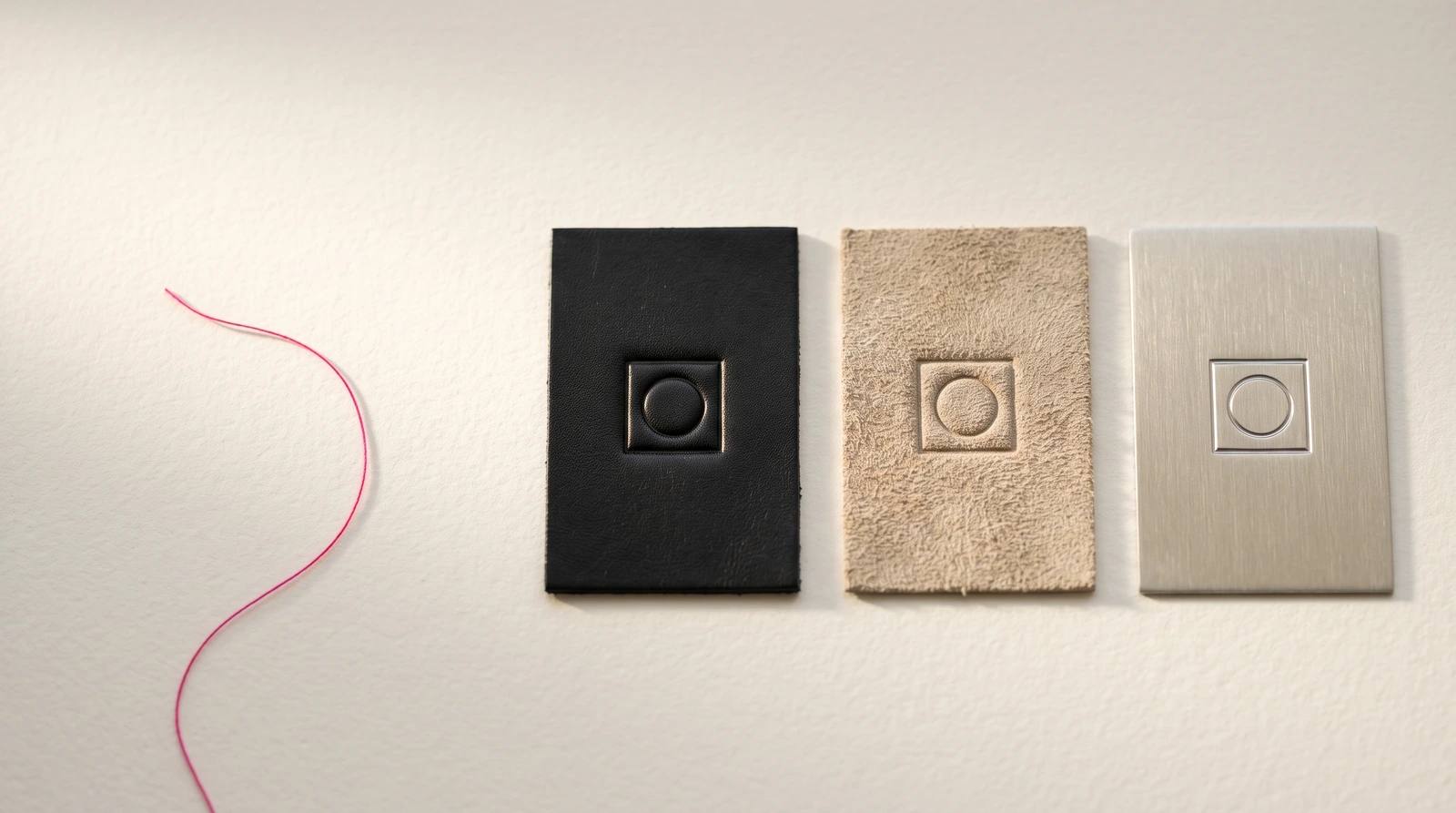
Your logo now rides every lookbook frame as a photograph of the mark on its real material, and the frame is graded against the photograph that rode it. Where a piece carries the mark, it comes back exactly as it is. Where a piece carries none, none may appear. That second sentence took a live failure to earn, and this post tells both halves.
The confession first
For as long as FLAM has graded frames, the rubric has carried a question about your logo. It is the heaviest kind of defect a house can take: a customer does not read a mangled mark as a rendering artefact, they read it as a counterfeit. The question's own wording ends "…or is not the mark in the reference."
There was no mark in the reference. There never had been. Brand identity in the product was four columns of prose — a vision paragraph, a vibe, a palette, keywords — and not one pixel. The references that ride a lookbook frame are your garments, a ground and your model. A garment photograph may show the mark at four pixels wide, or from behind, or not at all.
A model asked to compare against a reference that never arrived does not say "I cannot tell." It says nothing, and in a grading system, nothing reads as a clean score. We measured this directly: the same frame scored 50 and flagged with its reference attached, and 100 and clean without it. So the logo question was not a weak check. It was a guaranteed pass, applied to the one defect that cannot ship, on every lookbook frame we had ever developed for a house with a logo.
The fix is not a better question. The fix is to put the mark in the reference, and to withdraw the question on any frame where it did not ride. A question the house cannot answer is no longer asked. That makes the rubric stricter and honester in the same move, and it is why scores from before and after this release are never averaged into one trend line.
Why a photograph, not the vector
The obvious version of this feature takes your logo file. We built the other one on purpose: you photograph the mark as it exists in the world — embossed into black calf, woven into a satin label, foiled on a swing tag — and register each photograph with its material named.
A model shown a flat logo on white does the literal thing: it renders a flat logo on white, sitting on the garment like a sticker. A model shown the mark pressed into leather has seen how the material takes it — the depth of the emboss, the way thread breaks a curve, the sheen of the foil. The rendition is not decoration around the logo; it is the information the flat file does not hold.
At most two renditions travel with any frame, in the order you set. This is a budget decision, not a technical one: past two, the references repeat themselves while the model's attention spreads thinner over everything else it was asked to hold.
A collection can carry its own set — foil where your main line embosses — and the set answers whole. It is never merged with the house's. Two finishes in one request is a contradiction, and a model resolves a contradiction by inventing a third finish that exists on neither piece.
The ruling we had to make in week one
The first live proof exposed a bug in our own wording. A plain knit dress, no logo anywhere on it, developed into a frame with the mark painted on the chest. The sentence that introduced the rendition read as an instruction to place the mark, and the model obeyed it.
The founder's ruling settled the semantics for good: fidelity, never placement. The rendition exists so that a piece which already carries the logo, printed on it or stitched into it, does not get it distorted. It is never a licence to add one. And the reverse binds equally: if the original piece carries no mark, none may appear in the frame.
The grading now reads both directions. A mark distorted or replaced where the piece carries one is a defect; a mark invented where the piece carries none is a defect; and the correction sent back for a redraw says which of the two happened. We kept the frame with the painted-on chest as the red evidence — the before that proves the clause can fail.
The judge's eyes were also fixed
Building this surfaced a second bug that had been live and silent. The judge carries four references into a reading, and it used to take the first four in staging order. On a look with several pieces plus a ground, the model's own photograph — staged last, by design — never arrived. The judge was being asked "is this your model?" against references that did not include her.
The four are now chosen by what discriminates, not by position: the model and the mark are carried in first, then the pieces the crop actually shows. Same budget, honest contents.
What this costs
Nothing new. A rendition upload is an ordinary upload, the mark rides a generation you already paid for, and the reading has always been free. The price book grew by zero rows.
What is deliberately not here
- Packshots. It is where a mark matters most for a bag or a swing tag, and it is deferred for a mechanical reason, not a design one — that lane stages its bytes down a different door. It is next, not dropped.
- Placement enforcement. The house records where the mark sits on a piece, and uses it to find the mark it must preserve. It does not yet verify position, because a position claim needs its own question and its own calibration before it can be asked honestly.
- Reading the mark off your uploads automatically. Real, and a paid analysis, so it needs a price before it needs code.
Related
- How to register your renditions: the brand's mark.
- Why an unanswerable question is worse than no question: every frame is looked at before you open it.
- What shipped, and when: /changelog#the-brands-mark.
Questions
- What is a mark rendition in FLAM?
- A photograph of your logo as it actually appears on a material — embossed on leather, woven into a label, foil-stamped on a swing tag. Not the flat vector on white: a model shown only the flat version renders a sticker. You register each rendition with its material named, and one or two of them ride every lookbook frame as reference images.
- Will FLAM place my logo on a garment?
- No, and this is a rule rather than a limitation. The rendition is ground truth for a mark your piece already carries. A piece that shows the mark in its own photograph is held to the rendition — same form, same weight, same finish. A piece that carries no mark stays plain, and a frame that invents one is flagged.
- How many renditions ride a frame?
- At most two, in the order you set. Past two, the reference budget is spent telling the model the same thing again while its attention thins across all of them. The panel shows which renditions will travel, so you can read the answer before you develop.
- Does the mark cost tokens?
- Nothing new. Uploading a rendition is an ordinary upload, the mark rides a generation you were already paying for, and the grading has always been free. No new price appears anywhere.