The model you already have
A house that has shot with the same girl for three seasons has a model already — it is just spread across four hundred files. Turning that into something a machine can cast means putting four views of one face on one sheet, which is the smallest unit of identity there is.
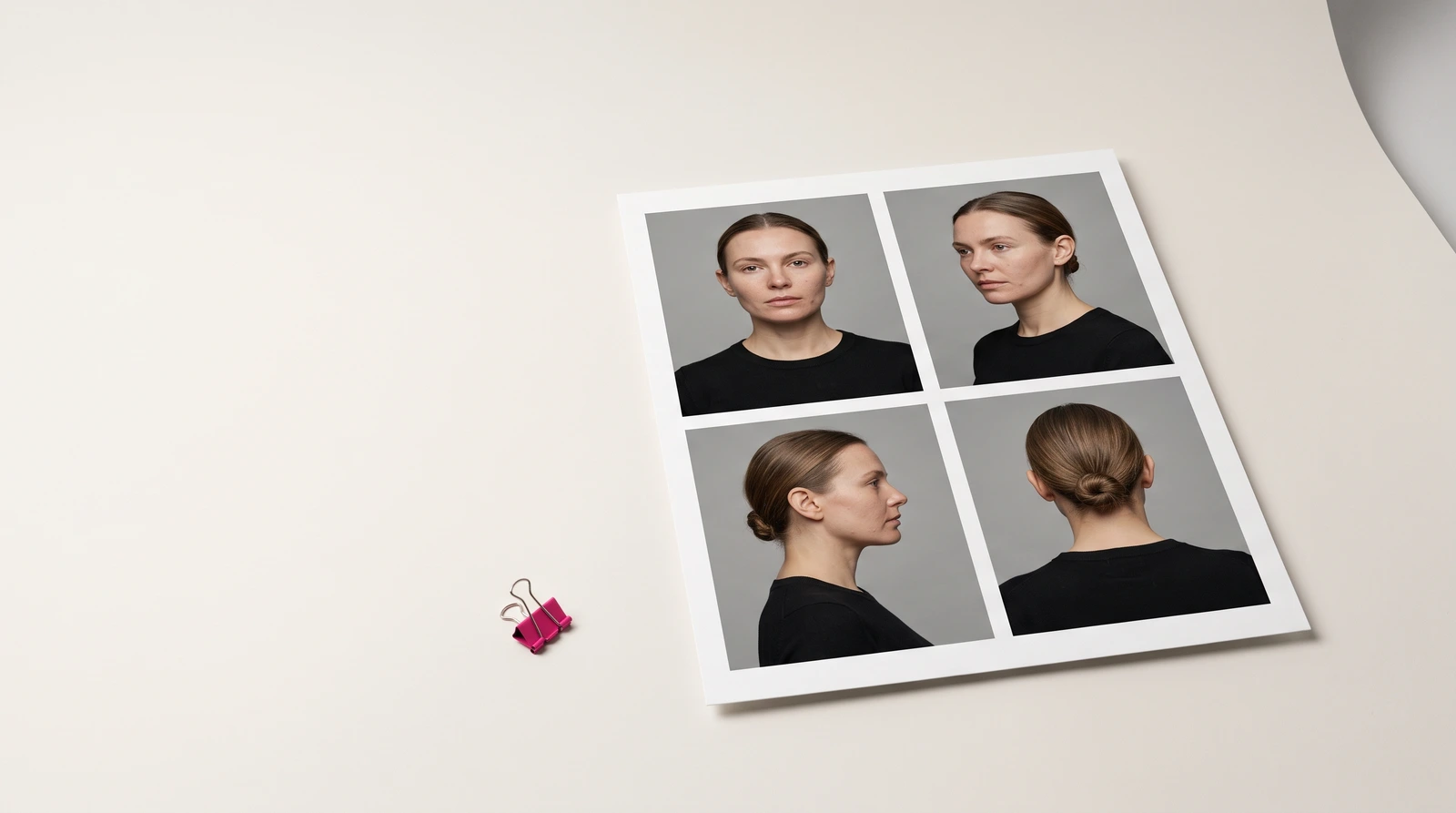
A house that has shot with the same girl for three seasons already has a model. It is just spread across four hundred files, and none of them is the one you would hand a machine. Casting her properly means collapsing all of it into a single sheet — four views of one face, laid out the way an agency lays them out — because one sheet is the smallest thing that can carry an identity from one frame to the next.
That is what we shipped. You drop the photographs you have; the house gives you back the sheet you do not.
Why a folder of photographs is not a model
The obvious version of this feature is a folder. Upload every frame you have of her, and let the house consult all of them on every develop. We built the opposite, and the reason is not a technical limitation — it is what happens when you give a model four opinions about one face.
It averages them. Not deliberately: it has no way to know that the sharp studio frame should outrank the phone photograph from the fitting, so it takes a little from each, and the face that comes out is a relative of the girl you shot. Run that over forty frames and you get a family rather than a person. The drift is small enough per frame that nobody catches it until the lookbook is laid out together, which is exactly when it is expensive.
One sheet ends the negotiation. Four panels, one canvas, one statement about what this face is — and the develop attaches it as a single reference with nothing to weigh against it.
What a digitals sheet actually is
Borrowed intact from casting, where it has been the answer to this problem for fifty years. An agency sends a casting director a sheet: the same girl front, three-quarter, side, back. Flat even light. Neutral expression. A black top and nothing else. No mood, no retouching, no styling opinion.
Every one of those constraints exists for the same reason — the sheet is not selling her, it is describing her. A smile changes the shape of the lower face. Hair across the ear removes information a casting director needs. Directional light invents bone structure that is not there. The sheet strips all of it out so that what remains is the face.
A generative model wants the identical thing for the identical reason, which is the part that surprised us: we did not have to invent a format for machine casting. It already existed, and it was already right.
The three things the sheet will not bend on
Writing the instruction for that sheet took longer than building the feature around it, and what it taught us is that a long instruction loses its own beginning. Three devices survive in the version that ships, and each one is there because a sheet drifted without it.
The opening names what may not change. Facial structure, bone structure, proportions, skin tone, eye shape, lips, nose, eyebrows. Without the enumeration the model treats the reference as inspiration and the identity walks quietly across the four panels — panel one and panel four are cousins.
The hair block leads with the lock, not the description. Describing the hair is not enough: "medium brown, straight, centre part" gets you medium brown straight hair in four different cuts. The line has to begin by saying the hair is identical to the reference and only then describe it. Hair inconsistency was the first thing every director noticed, and it is a spatial question — whether hair sits in front of the ear or behind it — which is a known weak spot in these models rather than something the wording alone can settle.
The closing line restates the whole constraint. Same person, same face, same hair, same proportions; only the camera angle changes. By the end of two thousand characters the opening has faded, and the last thing read carries weight the middle does not.
One more, learned late: the front panel is a tight head-and-shoulders close-up, not another half-body. Four half-body panels give you four small faces, and small faces are where these models are weakest by their makers' own admission. One large face on the sheet is what makes it usable as identity at all.
The house tells you before you look
The sheet is marked the moment it lands, by the same judge that reads every frame you develop — but wearing different glasses. A digitals sheet has no garment, no logo and no scene, so those questions are taken away from it. Left in, they come back empty, and an empty answer reads as a perfect one. That is not a hypothetical: an unanswerable question is the most reliable way we know to manufacture a clean score.
What it asks instead is what actually goes off on a sheet. Is it a 2×2 or did it come back as a strip. Do the four panels agree on the person. Is the hair over an ear. Is she smiling on a sheet that exists to be neutral. Is it the gender you asked for. Are two of the panels the same view.
If something is off you hear it first, in one line, before you have opened anything. Say what you saw — "the hair is in front of the ear in the top-right panel" — and it develops again with your sentence ranked above every other instruction in the brief. At the ordinary price. The house does not sell you a free apology; it names what it sees and lets you decide whether it is worth thirteen tokens.
What it costs, and where the money moves
Looking at your photographs is free. Reading the face is one token. The sheet itself is one image generation at the ordinary image price — thirteen tokens at full size, nine at the smaller one — and it is quoted on a card before anything moves.
Full size is the default, which is a real decision rather than an upsell. A 2×2 at the smaller size gives each panel about 512 pixels of face, which is under the floor every one of these models states for a person reference. The panels have to be large enough to be faces.
What we did not build
Not a route. The casting rail's door opens the chat with the sequence armed, and everything after that happens in the conversation. A separate wizard screen would have meant two implementations of the same seven steps, and the second one is always the one that falls behind.
Not a new price. A sheet is an image generation and it costs what an image generation costs. There is no casting fee.
Not a new kind of thing. The sheet is an asset, and the asset id is the model — which is why the moment it hangs on your rail it is castable everywhere a model goes, and nothing downstream had to learn a new parameter.
What the sheet does not hold
A digitals sheet is four head-and-shoulders panels. It settles a face across forty frames and it says nothing at all about the body that face sits on, or about how that person looks when they are not being neutral — and neutral is the one expression the sheet is deliberately built out of.
Both gaps show up in the same place: a brief. Ask for a smile and the house has never seen this model smile, so it invents one, and the smile it invents is a stranger's. Put a coat on her and the drape hangs on proportions nobody read.
So the dossier is two more sheets on the same pattern, offered once the face holds: a range sheet — the same person wearing four named expressions — and a build sheet, two full-length panels with the body written out in the vocabulary a call sheet uses. Height, build, presence, posture, hands. Hands are on that list because hands are the thing these models get wrong most reliably and nothing we had ever described them.
The rule that makes it worth having is the same rule the face read follows: a field the house could not see comes back empty and stays empty. A guessed height is a body you have to argue with, and you would not know it was a guess. That is also why the build sheet refuses a portrait crop outright — it reads proportion, and there is no proportion in a crop.
It is optional in the literal sense. The casting completes without it, "not now" costs nothing, and you are not asked twice.
Related
- How to run it, step by step: cast your own model.
- The two optional sheets, and what each one changes: /changelog#her-range-and-her-build.
- Why consistency is a property of the set rather than the frame: the same look, every frame.
- What shipped, and when: /changelog#bring-your-own-model.
Questions
- How many photographs does FLAM need to cast a model?
- Two to four of the same person. One will work and eight is the ceiling, but past four the identity tends to average rather than sharpen. What matters more than the count is that one of them shows the face large — filling roughly half the frame — because that is the frame the identity is locked from.
- Why does a model have to be a collage rather than a folder of photographs?
- Because the collage is one image, and one image is what a develop can attach as a reference. Four separate files give the model four separate opinions about the same face and it averages them. Four views on one sheet give it a single statement it can hold across a whole shoot.
- What is a model digitals sheet?
- It is what an agency sends a casting director: the same person photographed front, three-quarter, side and back, in flat even light, with neutral expression and minimal styling. No mood, no styling opinion, no retouching. It exists to describe a face accurately, which is exactly what a generative model needs from a reference.
- Can I bring a model I already have a digitals sheet for?
- Yes. Register the sheet as-is on the casting rail and skip the develop entirely. The wizard exists for the far more common case: a house that has shot the same person for three seasons and has four hundred loose frames instead of one sheet.